






People-friendly lighting controls
BRE (Building Research Establishment) is an independent, research-based consultancy, testing and training organisation, operating in the built environment and associated industries.
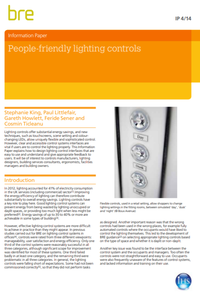
People-friendly lighting controls (IP 4/14) was written by Stephanie King, Paul Littlefair, Gareth Howlett, Feride Sener and Cosmin Ticleanu, and published by BRE on 30 May 2014.
In 2012, lighting accounted for 41% of electricity consumption in the UK services sector (including commercial). Improving the energy efficiency of lighting can therefore contribute substantially to overall energy savings.
Lighting controls can allow significant energy savings, and new techniques, such as touchscreens, scene setting and colour changing LEDs, allow flexible and sophisticated control.
Good lighting control systems can prevent energy from being wasted by lighting unoccupied or daylit spaces, or providing too much light when less might be preferred. Energy savings of up to 30 to 40% or more are achievable in some types of building, but clear and accessible system interfaces are necessary if users are to control the lighting properly.
This 8-page information paper explains how to design lighting controls interfaces so that they are easy to use, easy to understand, and give appropriate feedback to users. It is intended for controls manufacturers, lighting designers, building services consultants, ergonomists, facilities managers and building owners.
Its contents are:
- Introduction
- BRE lighting controls experiment
- Findings
- Conclusions and recommendations
- References
[edit] Related articles on Designing Buildings Wiki
- Adequate lighting.
- BRE articles on Designing Buildings Wiki.
- BRE Buzz articles on Designing Buildings Wiki.
- BREEAM.
- Building Research Establishment.
- Commercial lighting.
- Daylight lighting systems.
- General lighting v task lighting.
- Health and wellbeing impacts of natural and artificial lighting.
- Human-centric lighting.
- Lighting and energy efficiency.
- Lighting control systems.
- Lighting.
- Smart lighting market to 2020.
- Smart office lighting.
Featured articles
Check out some of the best features and news from Designing Buildings as well as key stories from around the web.

Sir Edwin Lutyens: Britain's greatest architect? Book review.

CIOB publishes free template to help assess and manage risks.
ECA's reflections on Party Conference season

Burnham wants to be confident of winning before asking for a fresh mandate.
New Chief Construction and Scientific Adviser

Sergio Cavalaro, Professor of Infrastructure Systems at Loughborough University.
Building safety levy for England

CIAT publish estimator tool for members.

Water sector faces a growing crisis that could slow the delivery of vital infrastructure.
Undervaluing our industrial past

Heritage value changes as taste for building styles changes.
Changing expectations around competence and compliance

New information sheet from CIAT.
Grenfell investigation files passed to CPS

Angela Rayner apologises on behalf of the British state.

Electrical contractors need to understand the practical implications.

The real barrier to getting more value from digital technology.

Your guide to The Construction Reset at UKCW Birmingham.